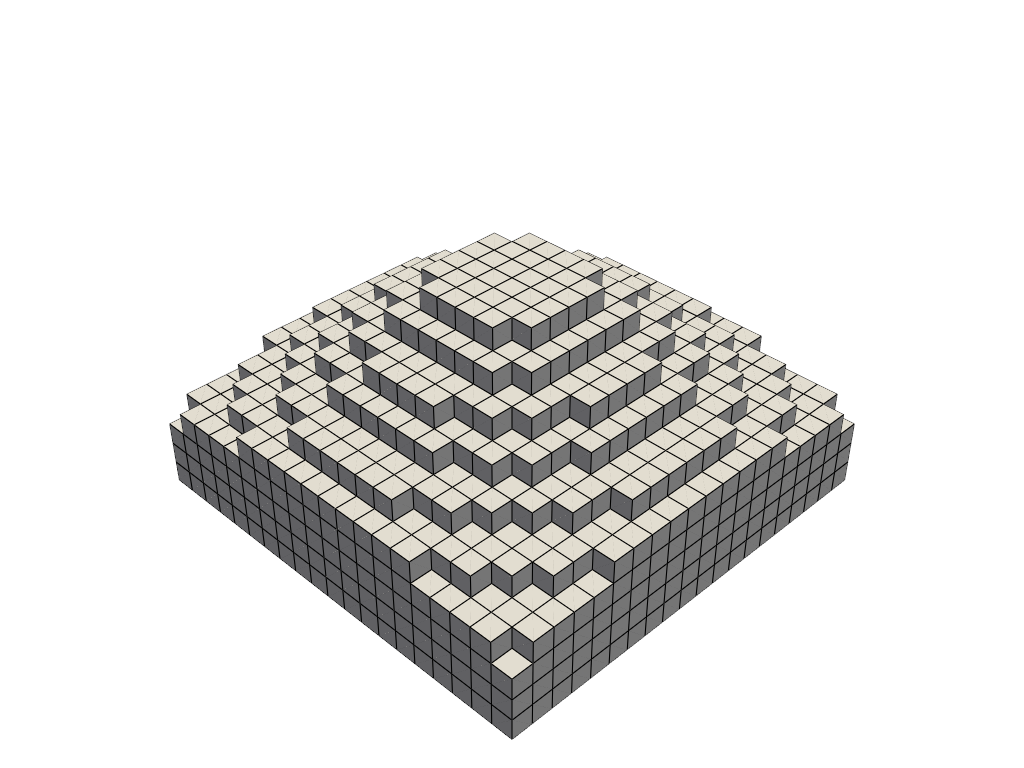
Topology optimization of a permanent magnet#
In this example the topology of a permanent magnet with magnetization \(\vec{M} = (0,0,M_z)\) is optimized to produce a maximum field in z-direction in a single point above the cubic design region.
Import libraries#
Import neccessary libraries and set backend to JAX and pyvisa rendering to static mode.
[1]:
import jax
import jax.numpy as jnp
import pyvista as pv

import neuralmag as nm

nm.config.backend = "jax"
pv.set_jupyter_backend("static")
2025-09-19 14:55:37 NeuralMag:INFO [NeuralMag] Version 0.9.3
2025-09-19 14:55:37 NeuralMag:INFO [NeuralMag] Backend set to 'jax'.
Create mesh and state#
Create state and set fixed magnetization in z-direction
[2]:
mesh = nm.Mesh((20, 20, 12), (5e-9, 5e-9, 5e-9))
state = nm.State(mesh)

state.material.Ms = 1.0
state.m = nm.VectorFunction(state).fill((0, 0, 1))
2025-09-19 14:55:38 NeuralMag:INFO [Mesh] 3D, 20 x 20 x 12 (size = 5e-09 x 5e-09 x 5e-09)
WARNING:2025-09-19 14:55:38,199:jax._src.xla_bridge:794: An NVIDIA GPU may be present on this machine, but a CUDA-enabled jaxlib is not installed. Falling back to cpu.
2025-09-19 14:55:38 NeuralMag:INFO [NeuralMag] Set default device to 'TFRT_CPU_0'.
2025-09-19 14:55:38 NeuralMag:INFO [NeuralMag] Set default dtype to 'float32'.
2025-09-19 14:55:38 NeuralMag:INFO [State] Running on device: TFRT_CPU_0 (dtype = float32, backend = jax)
Create dynamic attribute for material density \(\rho(\vec{x})\)#
We create a dynamical attribute state.rho that takes a scalar field state.rho_m and overrides the upper two layers of cells to be air.
[3]:
state.rho = nm.CellFunction(state, tensor=lambda rho_m: rho_m.at[:, :, 10:].set(state.eps))
state.rho_m = nm.CellFunction(state).fill(1.0)
Setup demag field#
We set up the demag-field class, register it with the state and get a plain function for the demag-field computation with the masked material density rho_m as a first parameter.
[4]:
demag = nm.DemagField().register(state, "demag")
demag_func = state.resolve("h_demag", ["rho_m"])
2025-09-19 14:55:38 NeuralMag:INFO [DemagField] Register state methods (field: 'h_demag', energy: 'E_demag', energy density: 'e_demag')
2025-09-19 14:55:38 NeuralMag:INFO [DemagField]: Set up demag tensor
Define loss function#
We define the loss function as negative absolute of the field’s z-component in a central point above the design region \(\vec{x}_0\)
and compute the gradient function.
[5]:
def loss(rho):
    return -(demag_func(rho**3)[10, 10, 12, 2] ** 2)


grad_loss = jax.grad(loss)
Optimization loop#
Perform the optimization loop by updating rho_m with the negative gradient and clip the values of rho_m to the interval [eps, 1].
[6]:
learning_rate = 1e3

for i in range(100):
    grad = grad_loss(state.rho_m.tensor)
    state.rho_m.tensor = jnp.clip(state.rho_m.tensor - grad * learning_rate, state.eps, 1.0)
Write result and visualize#
[7]:
state.write_vti("rho", "topology-optimization/rho.vti")

mesh = pv.read("topology-optimization/rho.vti")
thresholded_mesh = mesh.threshold(value=0.5, scalars="rho")

plotter = pv.Plotter()
plotter.add_mesh(
    thresholded_mesh,
    color="white",
    lighting=True,
    smooth_shading=False,
    show_edges=True,
)
plotter.show()